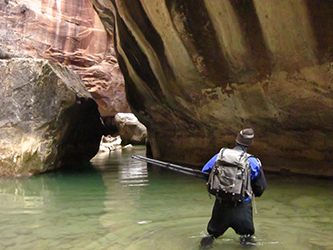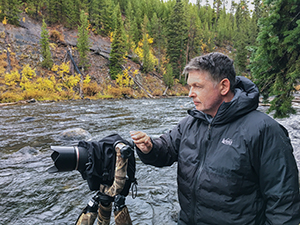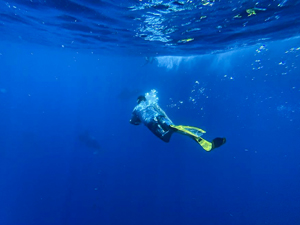
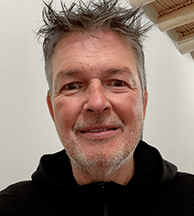
 bio Born in Germany, Gero Heine’s early experiences roaming the Black Forest and exploring the Alps and Dolomites sparked a lifelong passion for wilderness and wildlife. Likewise, his interest in photography began in childhood as he spent countless hours in bookstores, fascinated by compelling images of exotic and faraway lands.
As a high school student, he moved to Santa Cruz, California with his family. He soon became an avid surfer and his relationship with the natural environment was deepened by his connection with the ocean and frequent encounters with the abundant marine life of Monterey Bay.
After graduating from Pepperdine University and spending 13 years in the corporate world, Gero fulfilled a lifelong dream and began traveling to Africa. Profoundly affected by the vast expanse and astonishing diversity of wildlife, he resolved to pursue photography professionally. In addition to his now regular trips to Africa, he has found great inspiration in the stunningly captivating scenes of the Western United States, and more recently, India.
Gero has been actively involved in African conservation efforts and has participated in a lion research project. His work is exhibited in art shows, festivals, and galleries.
Amongst his numerous photography awards, Gero won the Wildlife Category of Nature's Best Photography Magazine's prestigious Windland Smith Rice International Awards in 2010. His image "Bison" has consequently been displayed at the Smithsonian National Museum of Natural History in Washington D.C. His image "Male Tiger Scratch-marking Tree" was recognized as Highly Honored in the Windland Smith Rice International Awards' Endangered Species Category and was recognized a Top 10 image by NANPA (North American Nature Photography Association) for 2011.
 artist statement My inspiration comes from the natural raw beauty that exists precariously beyond the relentless push of modern development. I believe that the essence of a scene can be revealed when one’s own perceptions are applied to pure, objective reality. With each photograph, I allow the natural elements of color, shape, and motion to resonate with an echo of my own feelings at that very moment. My goal is to present a timeless image that invites an individual emotional response for each viewer. I want the essential element in each subject to inform my aesthetic and technical choices. Color can be a powerful element triggering great emotional impact. Other scenes call for a black-and-white or sepia interpretation to best reveal the flow of shape, contour, and mood.
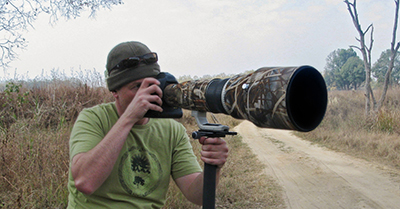 I began taking photographs in print and slide format. The advancements in quality over the last decade and a half in digital photography have made it an obvious transition for me to now photograph exclusively in digital format.
work description My work is comprised of approximately 70% wildlife and 30% landscapes. 10-15% of my body of work is black & white or sepia-toned. All of my subject matter is photographed on location in the wild. I now edit digitally for contrast and color correction, but to maintain photographic purity no elements are added or removed. Effects such as motion blur are created "in camera."
I carefully research my locations and previsualize my shoots and subjects. In landscape photography, the weather and clouds play an important function, and I can plan accordingly. With wildlife photography, the research goes more into the habits and locales of a certain species, and then animals do as they please, so I hope to be at the "right place at the right time." Animals are most active early in the morning or in the late afternoon/evening. This also coincides with the "golden hours" of landscape photography, when light is at its most dramatic. With landscapes, I often "see" an image in black & white. With wildlife, sometimes the drama unfolds in less than perfect light, and I reactively may choose to convert to black & white.
I have been drawn to my subjects for most of my life. One reason is the beauty and the excitement of being out in the bush, the desert or the mountains early in the morning. I cannot deny that there is a sense of escapism. Then there is the need to record history. This is especially true in today's rapidly changing world.
A Word on Wildlife Photography
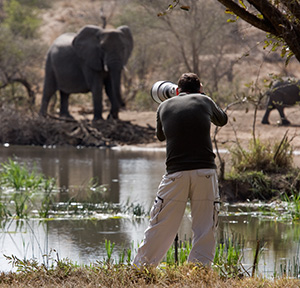
It is my goal to capture rare moments or thought-provoking, unusual compositions of animals in their natural environment. It is critical for me to record special and fleeting moments without interfering with the animals' natural behaviors in any way. I, therefore, maintain a safe and non-disturbing distance by using very large telephoto lenses and if possible, using my vehicle as a "blind." Sometimes animals will venture close enough to my vehicle where I can use a smaller focal length lens, however.